



While most Americans report overall satisfaction with their credit cards, CardRatings’ annual cardholder survey reveals that customer loyalty has clear boundaries. Terms changes — such as fee or interest rate increases, reduced rewards, lowered credit limits, or a single negative customer service experience — can quickly prompt cardholders to cancel their accounts.
Key takeaways from the survey
CardRatings surveyed more than 2,500 cardholders in late 2025 to measure overall satisfaction and identify key triggers that prompt account cancellations.
Overall, Americans feel pretty good about their credit cards. The chart shows a breakdown of how survey respondents assessed their feelings towards those cards:
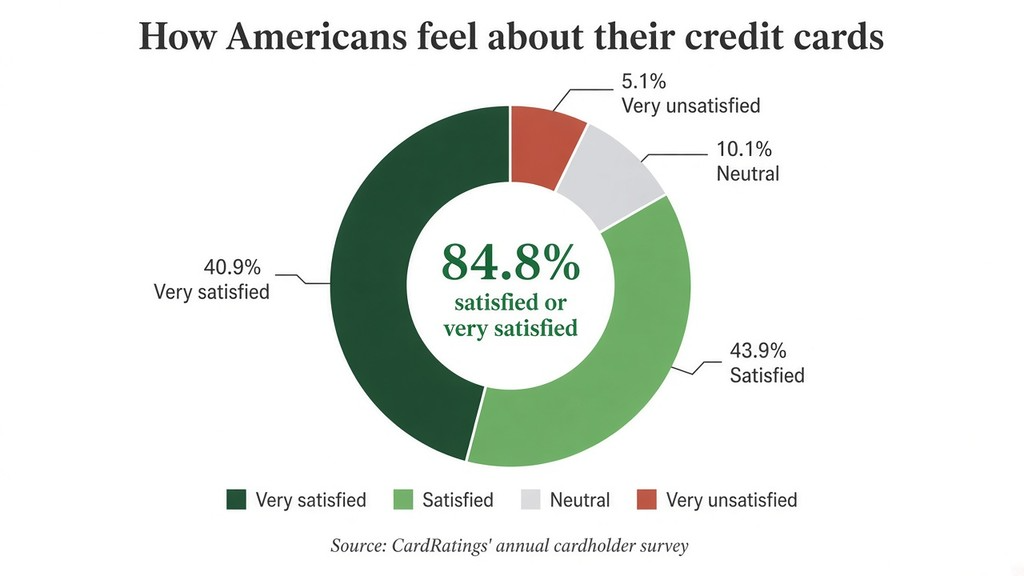
The green slices represent people with positive feelings towards their cards, while the red ones represent people with negative feelings. The white slice is neutral.
Nearly 85% of survey respondents said they were either “satisfied” or “very satisfied” with their credit cards. In contrast, just over 5% of cardholders described themselves as “unsatisfied” or “very unsatisfied” with their cards.
So far so good. But credit card companies shouldn’t take their customers for granted. The survey also found that over 40% of cardholders thought there was a better credit card for them out there somewhere, and another 40% thought their at least might be.
In other words, cardholders generally feel they may have better options. Digging a little deeper, the survey looked at things that might prompt customers to explore those other options.
Reasons for canceling a credit card might include anything from a change in the terms of the cardholder agreement to a negative customer service experience. The survey identified five factors that at least 10% of cardholders said would be the most likely trigger for them to dump a credit card.
Those hot buttons say a lot about what people expect from their cards, and what should keep credit card companies on their toes.
Top reasons cardholders say they would cancel a credit card
The CardRatings annual cardholder survey ranked the following as the top reasons they would cancel a credit card:
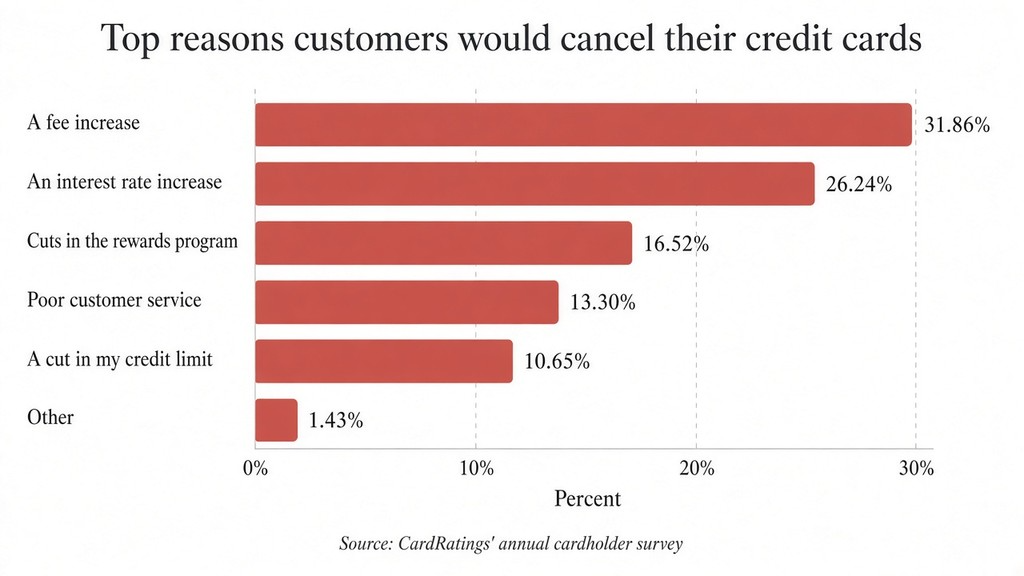
Above all, credit card customers are sensitive to price and value changes. Survey responses split into two primary categories:
- Value and service cuts (40%+ total): Slashed rewards, poor customer service, and reduced credit limits combined for over 40% of responses.
- Direct cost hikes (58% total): Fee increases were the single biggest dealbreaker at nearly 32%, closely followed by interest rate hikes at 26%.
How you use your card may affect your hot buttons
So what’s your hot button? Which of these factors would be most likely to prompt you to cancel a credit card? Or is it something else?
The factor you’re most sensitive to might depend on what kind of credit card customer you are:
- For example, suppose Donna regularly carries a sizeable balance on her card. That means she has to regularly pay interest on that balance. A rise in a card’s interest rate might cause her to start looking for alternatives.
- If Keith is a frequent traveler who racks up large numbers of reward points that he enjoys using, he’d be sensitive to changes in rewards policies. On the other hand, if Phil is a light credit card user who rarely earns significant amounts of rewards, he might be more put off by the introduction of an annual fee.
- If Bobby has had reason to contact customer service recently, a poor response may start him searching for a new card. In contrast, if Jerry has had his card for years without ever needing to contact customer service, he might be completely indifferent to how responsive his card’s customer support is.
Beyond how you use your card, who you are also plays a big role in what could trigger a cancellation.
Women are more tuned into interest rate increases than men
One example of how personal characteristics seemed to influence responses is in the percentage men and women who said an interest rate increase would be their most likely reason for cancelling a card.
Nearly 30% of women cited an interest rate increase as their most likely reason for cancelling. In contrast, a little under 23% of men gave the same reason.
This doesn’t necessarily mean that women are more cost-sensitive than men. Both men and women cited a fee increase as their most likely reason for getting rid of a card. In fact, the percentages for citing that reason were remarkably similar: 31.8% for men and 31.9% for women.
The reason why women are more sensitive to an interest rate increase may come down to the fact that women are more likely to carry a balance on their credit cards. That means they are also more likely to pay interest, and so an interest rate increase would impact more women than men.
In fact, roughly 7% fewer women than men said they typically pay their balance off in full every month. This exactly matches the 7% greater percentage of women who cited an interest rate increase as their most likely reason for cancelling a card. That makes sense, given that not paying a balance off in full means a customer will have to pay interest.
Older cardholders say “don’t mess with my rewards!”
The survey revealed a stark contrast in how age groups value rewards programs when deciding whether to cancel a card:
- Age 55 and over (23.9%): Twice as likely to cancel over rewards cuts, ranking it as their #2 trigger overall.
- Under 55 (11.6%): Placed reduced rewards near the bottom of their priorities, ranking it as their #5 trigger.
Because older adults often hold higher wealth and more leisure time, rewards programs carry significantly more weight in their loyalty to a card.
Even high earners worry about fees
While cardholder characteristics have some impact on reasons for cancelling, some issues seem to transcend these differences.
For example, lower-income families are most likely to feel squeezed by high costs. And yet, higher earners are the most likely income group to cite a fee increase as their most likely reason for cancelling a card.
Nearly 39% of people earning $200,000 or above said a fee increase was the factor most likely to get them to discontinue a card. This was higher than the overall average of 32% that cited this reason, and was the highest percentage of any income group.
The takeaway seems to be that just because people can afford to pay a higher fee doesn’t mean that they’re willing to do so.
Bottom line: Evaluate your card priorities before terms change
Cardholder loyalty has clear boundaries, and what triggers a cancellation depends heavily on how you use your card. Whether you are sensitive to interest rate increases, annual fees, or cuts to rewards programs, staying informed about your card’s terms ensures you are never caught off guard.
If a sudden change sours your relationship with your credit card, remember that you have options. Exploring competitive alternatives allows you to find a card that aligns with your financial goals instead of accepting unwanted fee increases or reduced value.
Frequently-asked questions about cancelling a credit card
Can I cancel a card at any time?
Can a credit card company still charge me fees and interest after I cancel?
How will I know if a credit card changes its terms?
ON THIS PAGE
- Key takeaways from the survey
- Top reasons cardholders say they would cancel a credit card
- How you use your card may affect your hot buttons
- Women are more tuned into interest rate increases than men
- Older cardholders say “don’t mess with my rewards!”
- Even high earners worry about fees
- Bottom line: Evaluate your card priorities before terms change
- Frequently-asked questions about cancelling a credit card


