

In an ideal world, you pay off your credit card in full each month. Doing so helps you avoid interest charges and allows you to earn rewards points guilt-free. In reality, life throws you curves that may make it challenging to avoid carrying a balance. Chase offers eligible cardholders a lifeline through its Pay Over Time feature. Chase Pay Over Time, formally known as “My Chase Plan,” lets cardholders on eligible accounts split purchases into predictable monthly payments. If you’ve received communications from the issuer and you’re wondering, “How does Chase Pay Over Time work?” this guide explains how it might help you manage purchases.
What is Chase Pay Over Time?
Chase Pay Over Time is a feature on qualifying Chase credit cards that allows cardholders to split purchases into monthly payments. Payments are the same amount each month and are made over time rather than in a single payment.
How it differs from traditional credit card payments
It is best to think of the Chase payment plan as similar to buy now, pay later (BNPL). The feature lets you make qualifying purchases and split payments into a predictable schedule. Doing so provides some structure that may help pay off a purchase over time.
This is the opposite of what occurs with traditional credit card payments. In a traditional model, cardholders make minimum payments, pay off the balance, or make some other payment. Traditional credit card payments offer flexibility to pay what you can, with making the minimum payment being advisable.
Chase Pay Over Time eliminates much of this flexibility, but it offers predictable repayment terms. Repayment schedules range from three to 24 months, with no early-payment penalty.
Types of purchases that qualify
Not all purchases qualify for Chase Pay Over Time. Purchases typically must be at least $100 to qualify. However, some purchases over that amount may not qualify. According to Chase, those include cash advances, any fees owed to Chase and purchases made under a promotion. Additionally, purchases older than 90 days may not be eligible.
If you shop on Amazon, purchases must be at least $50 to qualify. Amazon may make some categories ineligible, such as Whole Foods or Subscribe & Save purchases.
Chase Pay Over Time vs. My Chase Loan
My Chase Loan is a different feature offered to qualifying cardholders who need help managing their finances. Chase Pay Over Time operates like a BNPL, whereas My Chase Loan is similar to a personal loan. It may seem like a cash advance, but it’s not.
My Chase Loan lets cardholders borrow against their available credit line at a fixed APR that’s lower than their standard purchase APR. Loans must be at least $500. The maximum you can borrow depends on your creditworthiness, monthly spending and more. Funds go directly into your bank account, and repayment is necessary within 6-24 months, with no prepayment penalties.
Like Chase Pay Over Time, you can still use your card if you receive a My Chase Loan.
How to use Chase Pay Over Time
It’s easy to use Chase Pay Over Time. If you want to use the purchase financing feature, you must follow certain steps to activate it.
Step 1: Make a qualifying purchase
The first step to using Pay Over Time by Chase is to make a qualifying purchase. In most cases, the purchase must be at least $100. When making an online purchase, the platform will display a pay over time eligible icon.
If you’re shopping on Amazon, a purchase of $50 or more can qualify for financing. Be aware that eligibility can vary across platforms, and it’s not guaranteed that all purchases will be eligible for Chase Pay Over Time.
Step 2: Log in to your Chase account
Upon completing the purchase, you need to log in to your Chase account online or via the mobile app. Once in your account, go to the transaction history to view all of your transactions. Look for “Pay Over Time eligible” to identify an eligible transaction, and click on it.
Amazon purchases operate differently. On Amazon, select the “Financing offers available” button during checkout to finance your purchase.
Step 3: Choose a payment plan
You have multiple options when selecting Chase Pay Over Time to finance a purchase. Possible durations range from three to 24 months, so it’s important to select the option that’s best for you, as it will affect payment amounts.
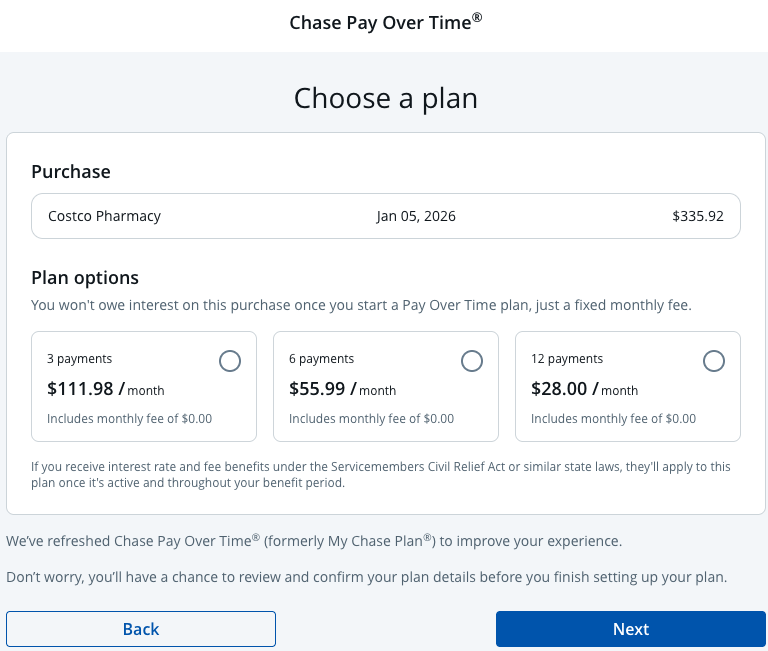
There is no interest charged for using the financing plan, but the monthly Chase Pay Over Time fee is up to 1.72% of the purchase amount. Amazon will show you possible repayment options when making purchases on its platform.
Step 4: Confirm and start your plan
Once you decide which plan is best for you, click the “Next” button.
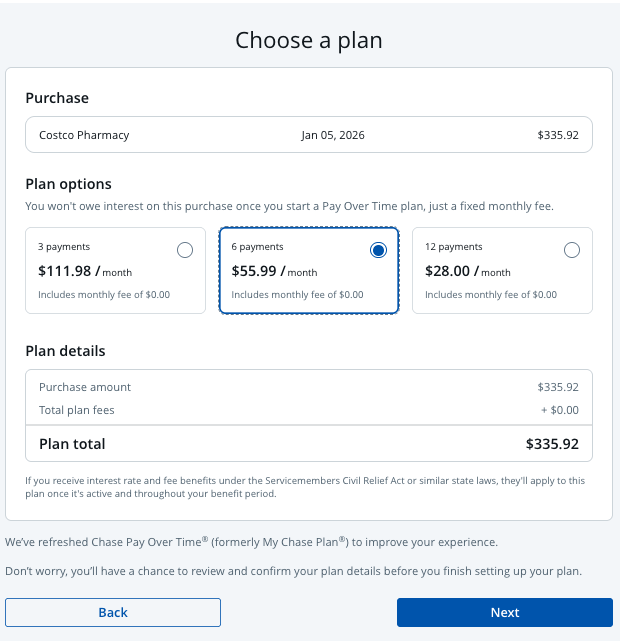
Chase will then take you to a screen that says “Does everything look OK?” and prompt you to click on the “Start this plan” button.
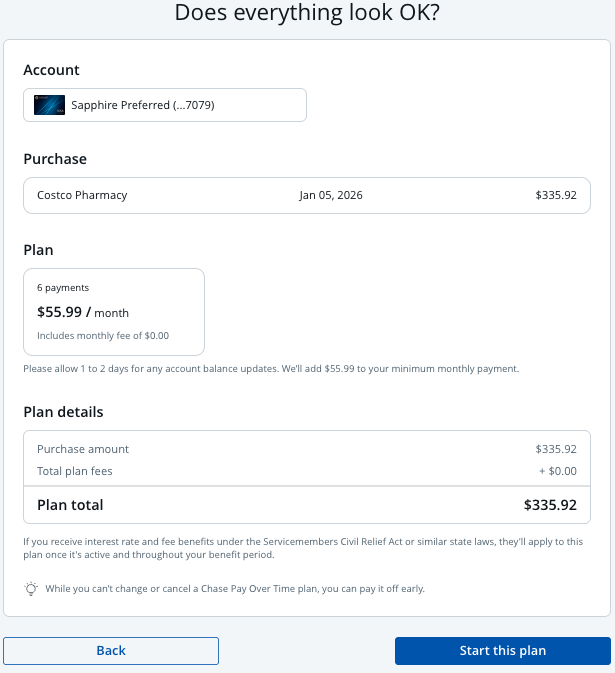
The agreed-upon amount then becomes part of the minimum payment you owe each month. It’s important to remember that the charge is still on your credit card account, and it’s commonly not possible to extend or change the plan. You can pay it off early, though.
Step 5: Track and manage your payments
When you use Chase Pay Over Time, it is still important to avoid incurring interest charges. The bank simplifies this by having an “interest savings balance” payment option on statements. This balance allows you to avoid paying interest on new purchases while still making payments towards the Pay Over Time balance.
If you select to pay the balance in full, it will also repay the entire Pay Over Time balance. So, keep that in mind if you don’t want to repay the Pay Over Time balance early. Chase first applies payments to your financing obligations, then to the statement balance.
Fees, credit impact and limitations
Chase Pay Over Time makes it easier to manage your budget, but it’s important to consider how it can affect your available credit, as well as the fees.
Chase Pay Over Time monthly fee explained
There is no interest charged when you use Pay Over Time by Chase, but there is a monthly fee to consider. The Chase Pay Over Time monthly fee is up to 1.72% of the eligible purchase amount. It is a fixed monthly fee, not a variable one.
According to Chase, “The Pay Over Time fee will be determined at the time each plan is created and will remain the same until the balance is paid in full. The fee is based on the amount of each purchase transaction selected to create the plan, the number of billing periods you choose to pay the balance in full, and creditworthiness.”
Be careful to look at the total amount you will pay in fees, not just the monthly amount, as you may determine it’s not worth the fee.
Does Chase Pay Over Time affect credit score?
Using Chase Pay Over Time doesn’t directly impact your credit score, but there is one key pitfall to avoid: the balance still reflects on your account.
If you continue to maintain a high revolving balance, it can affect your credit utilization ratio. The ratio is the second-largest component of your credit score, so it’s essential to keep it from creeping too high.
Can you pay off early without penalty?
Yes, it is possible to pay off your Chase Pay Over Time early. There’s no penalty or fee to repay it early.
Chase doesn’t let users change or alter the plan, but if you pay off your credit card in full, it will repay the Pay Over Time balance.
Does Chase Pay Over Time reduce the balance?
Chase Pay Over Time doesn’t reduce what you owe. It merely changes how a portion of your balance is repaid.
The Pay Over Time balance remains part of your overall obligation and uses a portion of your available credit until it’s repaid. Do keep in mind that Chase may limit the number of plans you can have. And, if you have one via Amazon and miss the minimum payment, it can cause late fees and interest charges.
When to use Chase Pay Over Time vs. other options
Pay Over Time by Chase is just one option for spreading payments. Not all options may work for you, though.
Comparing with 0% APR credit cards
Using a 0% APR credit card can be a helpful way to finance a large purchase. You will pay zero interest on purchases during the promotional period, which can be up to 18-21 months. While ideal for large purchases, they lack the structure of Chase Pay Over Time.
If you can repay the balance within the introductory period, a 0% card is often better, assuming your credit is good.
When a personal loan might be better
A personal loan is best when you’re making a significant purchase, and you want a fixed payment. Depending on your creditworthiness, the interest rate on a personal loan may be lower. Personal loans also don’t impact credit utilization ratios.
If the purchase isn’t that substantial, using Chase Pay Over Time may be more useful, especially if you can repay it within a year.
Is Chase Pay Over Time worth it for small purchases?
Using Pay Over Time by Chase for smaller purchases is often about convenience rather than need. However, overuse of the feature can normalize relying on debt for purchases.
It’s best to use a safeguard when considering the feature. Use it for planned, necessary purchases to help you avoid carrying a balance with a high APR.
Tips for avoiding overuse of payment plans
It’s best to view Chase Pay Over Time as a tool that you rarely use, not a default payment option. To avoid overuse, it’s best to follow certain guidelines, including:
- Set a personal cap for active plans
- Don’t use it if you weren’t planning on the purchase, or it’s not an emergency
- Calculate your credit utilization ratio before using
- Use the “interest saving balance” feature to help avoid interest payments
Chase Pay Over Time is a helpful tool, but overuse can lead you to unintended consequences.
Bottom line: Is Chase Pay Over Time worth it?
Chase Pay Over Time can be a worthwhile option when you need to finance a purchase over time without incurring interest. When you use it wisely, you can make a large purchase without applying for a new 0% APR card, with no guarantee of approval. It’s best to avoid using the BNPL tool whenever possible. When you do use it, pay it off within the terms to avoid hurting your credit score.